If you’re worried your child isn’t hitting milestones on time, New York City’s Early Intervention Program (EI) is the place to start. It’s free. It’s open to every NYC family, regardless of income or immigration status. And it can include ABA therapy. [1][2]
Here’s exactly how it works, step by step.
What Is the NYC Early Intervention Program?
Early Intervention is a New York State program for children under 3 years old who have a developmental delay or a diagnosed condition likely to cause one. [2] It’s administered locally through the NYC Department of Health.
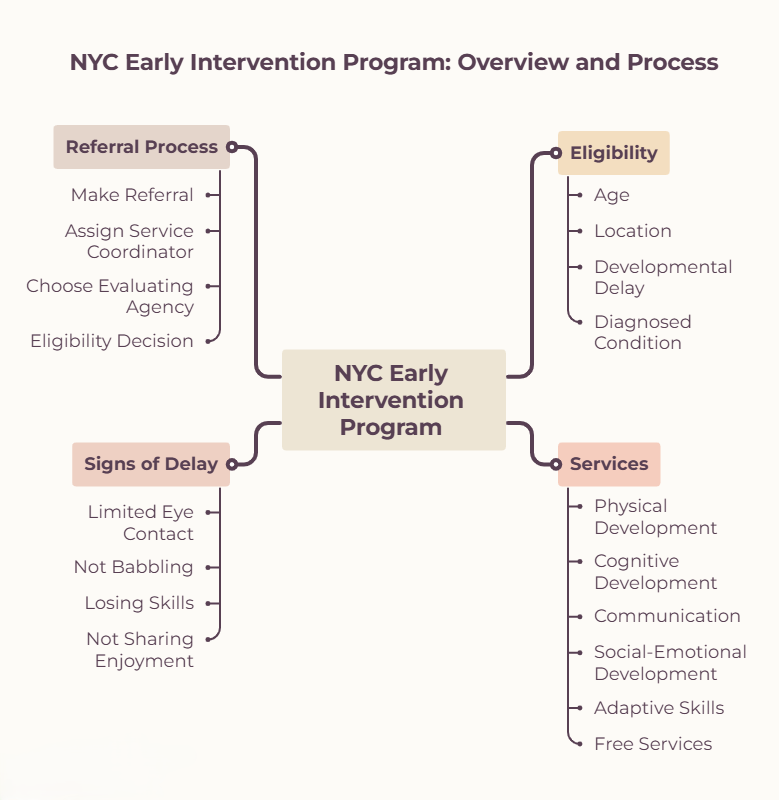
It covers delays in five areas:
- Physical development (including hearing and vision)
- Cognitive development
- Communication
- Social-emotional development
- Adaptive (daily living) skills
Services are free to families. Insurance or Medicaid may be billed in the background, but you’re never charged directly.
Signs Your Child May Need Early Intervention
You don’t need to be certain something is wrong to start this process, a suspicion is enough. Some things worth mentioning to your pediatrician or referring directly for evaluation:
- Limited eye contact or response to their name
- Not babbling, gesturing, or using words by the expected age
- Losing skills they previously had
- Not showing interest in playing with others or sharing enjoyment with you
The CDC’s “Learn the Signs. Act Early.” The program has free milestone checklists by age, from 2 months through 5 years. Pediatric guidance recommends general developmental screening at 9, 18, and 30 months. It recommends autism-specific screening at 18 and 24 months, or anytime a parent raises a concern. [5][6] None of this confirms anything on its own. It’s simply a reason to make the referral instead of waiting.
Who Is Eligible for NYC Early Intervention?
Your child may qualify for EI if they:
- Live in New York City
- Are under 3 years old (up to 2 years, 11 months)
- Have a developmental delay, or
- Have a diagnosed condition with a high chance of causing one (such as autism spectrum disorder, Down syndrome, or a hearing impairment)[4]
There’s no income requirement, and your child doesn’t need to be a U.S. citizen to qualify. [4] Every child referred is entitled to a free evaluation, even with a diagnosis already in hand, the evaluation still happens, since it’s what shapes the actual service plan.
How to Start the NYC Early Intervention Referral Process
- Make a referral. Parents, pediatricians, daycare staff, or anyone with a concern can refer a child. In NYC, do this by calling 311 and asking for “Early Intervention,” or through the NYC EIP Referral Portal. [1][3]
- Get assigned a service coordinator. Within about 10 days, an initial service coordinator will reach out to walk you through the process and your rights. [3]
- Choose an evaluating agency. Your coordinator gives you a list of state-approved agencies. You pick one, and they conduct a free, multidisciplinary evaluation of your child.
- Get your eligibility decision. If your child qualifies, the next step, the IFSP meeting, must be scheduled within 45 days of your original referral. [3]
The Early Intervention Evaluation: What Actually Happens
A team evaluates your child across the five developmental areas listed above. If autism is suspected, this typically includes a closer look at social communication, play skills, and behavior, not just general milestones. There’s no cost to you, and evaluations are available in multiple languages.
If your child isn’t found eligible but is still under 3, they can be enrolled in Early Intervention Developmental Monitoring, a free program that tracks whether they’re meeting age-appropriate milestones going forward. [1]
The IFSP: Where ABA Gets Decided
If your child is eligible, your family and a team including your service coordinator, an early intervention official, and the evaluator build an Individualized Family Service Plan (IFSP). [2]
The IFSP spells out:
- Which services your child will get (speech, OT, PT, special instruction, service coordination, and others)
- How many hours per week
- Where sessions happen (home, daycare, or community setting)
This is the part parents often misunderstand: EI doesn’t have a service literally called “ABA” written into state law, it’s called Special Instruction. [4] Whether that special instruction is delivered using ABA methodology depends on which provider agency you select. Many NYC EI agencies do deliver ABA-based programming, run by BCBAs or certified special educators, but not every agency offers it. If ABA specifically is the approach you want, say so at the IFSP meeting and ask your service coordinator which approved agencies on your list provide it.
In practice, ABA-based special instruction for a toddler doesn’t look like a formal lesson. It’s usually played on the floor. The therapist follows your child’s lead with toys, songs, or snack time. Small, repeated chances to practice a skill get built in reaching for a toy instead of grabbing, pointing to ask for something, imitating a sound. The goal at this age is to build the skill into everyday moments, not to run drills.
One more thing worth checking: some private companies use “early intervention” in their name or marketing to describe general work with young children. That doesn’t mean they’re an approved vendor of the NYS Early Intervention Program. If you’re referred to a specific agency, ask whether they’re an approved EI vendor under contract with NYC. If not, their services would likely be private-pay or insurance-based instead. (Our Parent’s Checklist for Choosing an ABA Provider covers exactly what to verify for any private provider.)
What Happens at Age 3? Leaving Early Intervention
EI eligibility ends at 3. Around 2 years, 9 months, your service coordinator should start transition planning with you. If your child will need continued support, the next step is the Committee on Preschool Special Education (CPSE), reachable through 311. [1] Some families also look at private ABA through health insurance during this transition. Reaching out to a provider like NYC ABA Therapy a few months ahead of the third birthday can help avoid a gap in services. (If you’re weighing setting options for that next step, see our In-Home vs. Center-Based ABA guide.)
Frequently Asked Questions
Does my child need an autism diagnosis to get ABA through EI?
No. A suspected delay is enough to trigger a free evaluation, you don’t need a diagnosis in hand to start the process.
How long does the whole process take?
By law, the IFSP meeting must happen within 45 days of your referral. In practice, timing depends on evaluation scheduling and which agencies have openings.
Is Early Intervention really free?
Yes. Insurance or Medicaid may be billed, but families are never charged directly for EI services.
What if we want more ABA hours than EI provides?
Some families supplement EI with private, insurance-covered ABA once specific gaps are identified, this is worth discussing with your service coordinator and, separately, with a private ABA provider such as NYC ABA Therapy. (It’s worth reading our guide to ABA waitlists in NYC before you start calling, so you know what to expect.)
This article is for general information and isn’t a substitute for personalized guidance from your Early Intervention service coordinator or a licensed clinician.
References:
[1] NYC Health – Early Intervention Program
[2] NY State Department of Health – Early Intervention Program
[3] Growing Up NYC (NYC.gov) – The Early Intervention Program
[4] NY State Department of Health – Early Intervention Program Overview (PDF)
[5] CDC – About Learn the Signs. Act Early.
[6] CDC – Developmental Milestones