There’s no single official tracker that publishes exact ABA waitlist times for New York City. Be skeptical of anyone who gives you a suspiciously precise number. What multiple NYC-area providers and industry sources do consistently report is a wide range, typically somewhere between 3 and 12 months. It depends on the provider, the setting (in-home vs. center-based), and your insurance. Some families wait less. Some wait longer. Here’s why, and what actually helps.
Why ABA Waitlists Happen in NYC
A few things are converging at once:
- Demand has grown fast. CDC surveillance data (2022 records, published 2025) found about 1 in 31 8-year-olds (3.2%) identified with autism spectrum disorder, up from 1 in 36 two years earlier. [1] More identification means more families seeking services at once.
- Diagnosis itself takes time before the ABA waitlist even starts. A Journal of Pediatrics study found the average delay from a child’s first developmental screening to an actual diagnosis is close to 27 months. [3] A separate peer-reviewed analysis found services often don’t begin for another 9 months after diagnosis. [2] The “ABA waitlist” most families feel is really the tail end of a much longer pipeline.
- The workforce hasn’t kept pace with demand. Even in a provider-dense market like NYC, more BCBAs and RBTs are being trained, just not fast enough to match how quickly diagnosis rates have grown.
- Insurance authorization adds its own delay. Some providers won’t start the waitlist clock until they have your diagnostic paperwork and confirmed coverage in hand.
How to Shorten Your ABA Waitlist in NYC
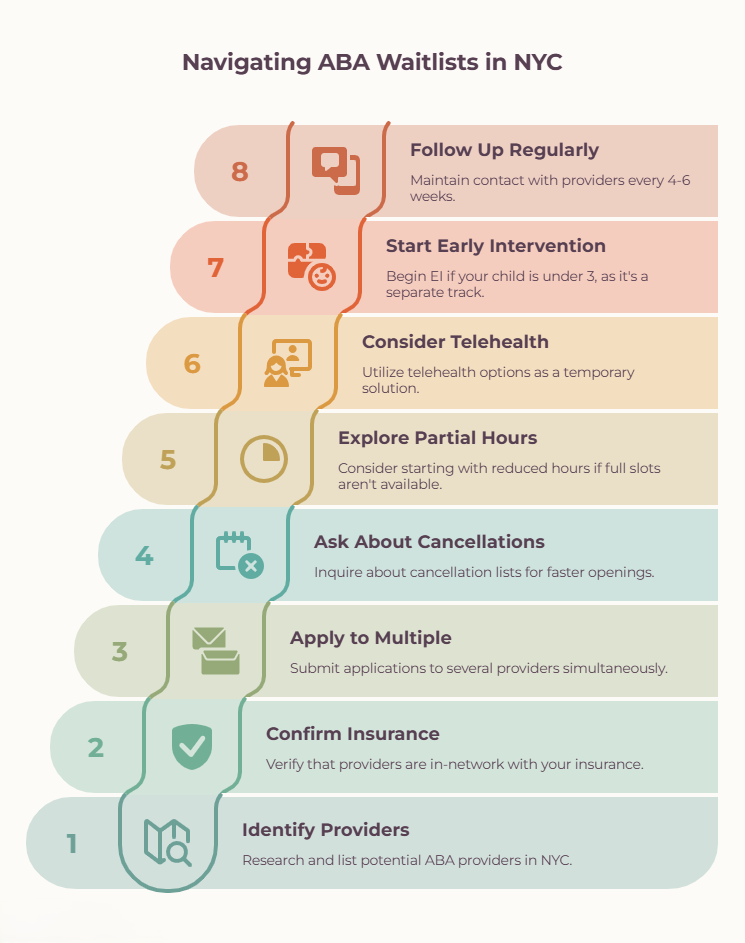
1. Get on multiple waitlists at once, not one at a time. Don’t wait to hear back from Provider A before contacting Provider B and C. Take the first genuine opening, and you can always decline the others.
2. Ask directly: “Do you keep a cancellation list?” Many providers maintain one separately from the main waitlist, and it moves faster. Being on both improves your odds.
3. Ask about partial-hours starts. Some providers can’t offer a full schedule immediately but can start your child at reduced hours while building toward the recommended intensity, better than waiting for a completely open slot.
4. Ask about telehealth as a bridge. Telehealth-delivered ABA and parent coaching have grown a lot and are increasingly covered by insurance. It won’t replace in-person therapy for every goal. But for parent training and some communication goals, it can start sooner and help while you wait. Worth asking about, whether you’re on a waitlist with NYC ABA Therapy or another provider.
5. If your child is under 3, start Early Intervention immediately, it’s a separate track. EI doesn’t require a formal autism diagnosis to begin, and it moves on its own timeline, funded separately from private insurance. Many families pursue EI and a private ABA waitlist at the same time rather than choosing one. (Full process in our NYC Early Intervention Program guide.) [4]
6. Confirm your insurance’s in-network status before you start calling. Calling providers who don’t accept your plan wastes real time. Ask your insurer for a current list of in-network ABA providers and verify it directly with the provider anyway, since these lists are often out of date. [5]
7. Ask your insurer about a “network gap exception.” If no in-network provider has near-term availability, some New York-regulated health plans allow an out-of-network provider to be covered at in-network cost. This applies when there’s a genuine gap in the network. [6] It varies by plan, self-funded employer plans are often exempt from state rules. Ask your insurer directly whether it applies to your ABA benefit. Don’t assume it does.
8. Follow up every 4–6 weeks instead of waiting passively. Providers often can’t reach families due to outdated contact info or full voicemail boxes. A short check-in call keeps you visible on the list.
A Word of Caution About ABA Waitlists
A long waitlist doesn’t automatically mean a provider is better. “No waitlist” doesn’t automatically mean a provider is worse or rushed, it can just mean good capacity planning. Either way, apply the same credential and process checks regardless of wait time, whether you’re calling NYC ABA Therapy or anyone else. (See our Parent’s Checklist for Choosing an ABA Provider for exactly what to verify.)
While you wait, it’s reasonable to ask your future provider whether parent coaching can begin before full sessions are available. It’s not a good idea to try to build your own ABA program from general online guidance, ask your care team for guidance they’ve actually approved for your child specifically.
Quick Checklist
- Get on multiple waitlists simultaneously
- Ask each provider about a separate cancellation list
- Ask about partial-hours or telehealth starts while you wait
- Start Early Intervention now if your child is under 3, no diagnosis required
- Confirm in-network status before calling providers
- Ask your insurer about a network gap exception if no in-network provider is available soon
- Follow up every 4–6 weeks
Frequently Asked Questions
How long is the ABA waitlist in NYC, really?
There’s no single official number — providers report a typical range of roughly 3 to 12 months, varying by setting, insurance, and location within the city.
Should I start Early Intervention even if we also want private ABA?
Yes, if your child is under 3, EI runs on its own track and doesn’t require a formal diagnosis, so pursuing both at once is common and doesn’t conflict.
Does a shorter waitlist mean lower quality?
Not necessarily. Wait time reflects capacity and demand, not clinical quality on its own, verify credentials and process the same way regardless.
Can insurance help me skip the wait?
Not skip exactly, but a confirmed in-network provider list and, in some cases, a network gap exception can shorten the practical delay. Ask your insurer directly what applies to your plan. [6]
This article is for general information and isn’t a substitute for personalized guidance from a licensed clinician or your insurance provider.
References
[1] CDC – Data and Statistics on Autism Spectrum Disorder
[2] Penney, Greenson, Schwartz, Estes – “On-Time Autism Intervention”: A Diagnostic Practice Framework to Accelerate Access, Frontiers in Psychiatry, 2022
[3] The Transmitter (reporting on a Journal of Pediatrics study) – Average autism diagnosis delayed by more than two years
[4] NYC Health – Early Intervention Program
[5] Autism Speaks – New York State-Regulated Insurance Coverage
[6] NY Department of Financial Services – Network Adequacy Requirements FAQ