If you’re searching “ABA therapy near me” or “ABA provider near Queens,” the results can feel interchangeable, warm photos, similar promises, insurance logos. But Queens is the largest borough in NYC by land area. It doesn’t behave like one neighborhood. A family in Astoria and a family in Far Rockaway deal with completely different commutes, transit options, and provider density. That matters more here than almost anywhere else in the city. “Best provider near me” often really means “best provider I can actually get to consistently.”
Here’s what to actually check, wherever in Queens you are.
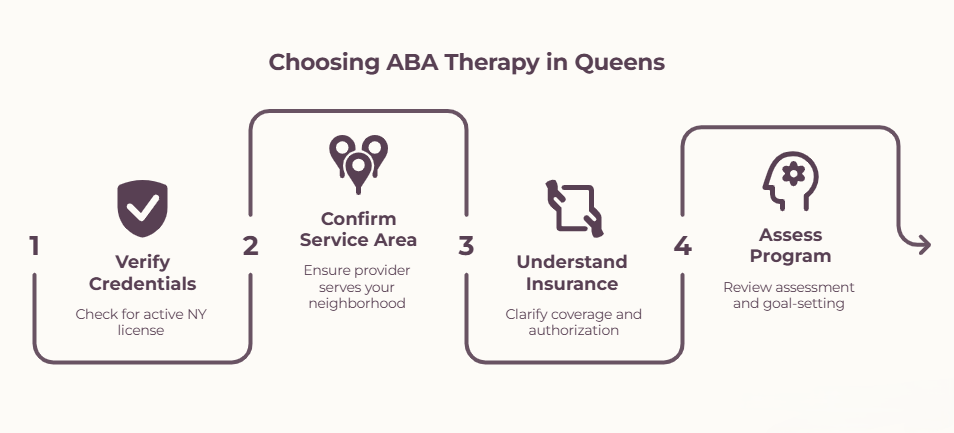
Finding ABA Therapy Near You, Wherever You Are in Queens
Roughly speaking, Queens breaks into a few distinct areas:
- Northwest Queens: Astoria, Long Island City, Sunnyside, Woodside
- Central Queens: Jackson Heights, Elmhurst, Corona, Forest Hills
- Flushing & Northeast: Flushing, Bayside, Fresh Meadows, Whitestone, College Point, Little Neck
- Eastern Queens: Jamaica, Hollis, St. Albans, Queens Village, Bellerose, Douglaston
- Southern Queens & the Rockaways: Ozone Park, Howard Beach, the Rockaway Peninsula
This is a big part of why in-home ABA therapy is especially common in Queens. It removes the need to cross the borough or fight Van Wyck Expressway traffic for every session. If you’re comparing providers, ask directly whether they actually serve your specific neighborhood, not just “Queens” in general. Service areas vary a lot between agencies. At NYC ABA Therapy, our in-home programs are built around exactly this, matching families with therapists who actually cover their part of the borough, not a citywide roster that thins out once you look closely.
Start With ABA Provider Credentials, Not Marketing
This is the single biggest thing families miss, in Queens or anywhere in NYC: “ABA experience” and “licensed to practice ABA in New York” are not the same thing. Since 2014, New York State has required behavior analysts to hold an actual state license. It’s called a Licensed Behavior Analyst (LBA) credential, issued through the NY State Education Department, and it’s separate from national BCBA certification. [1][2] A provider can be BCBA-certified nationally and still not be legally licensed to practice in New York. National certification is a pathway to the state license. It isn’t a substitute for it. [1]
How to check, in under 2 minutes, for free:
- NYSED’s online license verification search: confirms if a behavior analyst actually holds an active NY license [3]
- The BACB Certificant Registry: confirms national BCBA/BCaBA/RBT certification status and shows any disciplinary history [4]
If You’re Going Through Early Intervention (0–3) in Queens
If your child is under 3, ABA in Queens often starts through NYC’s Early Intervention Program rather than private insurance. Referrals work the same way regardless of which borough you’re in, call 311 and ask for “Early Intervention,” or use the NYC EIP Referral Portal. Once your child is enrolled, each borough, including Queens, has its own EI regional office for follow-up questions. [6] (We cover the full EI process step by step in our NYC Early Intervention Program guide.)
Confirm How They Handle Insurance and Medicaid
New York has required most insurance plans to cover autism treatment, including ABA, since a 2011 law took effect in November 2012. [5] Most fully-insured private plans and Medicaid in NY must cover medically necessary ABA. Self-funded employer plans, common with larger companies, are often exempt from the state mandate since they’re regulated federally. It’s worth confirming your specific plan type rather than assuming.
Ask any provider directly:
- Do you verify insurance benefits for us, or is that on our end?
- Do you handle prior authorization?
- What happens if a claim is denied?
Ask About Setting and Factor In Queens Geography
Not every provider offers every setting, and in a borough this size, commute matters as much as clinical fit. If a center-based option is outside your immediate area, ask honestly how far that really is at rush hour, not just the map distance. (We compare the tradeoffs in detail in our In-Home vs. Center-Based ABA guide.)
Ask How the ABA Assessment and Goal-Setting Works
A real program starts with a thorough assessment of your child’s specific skills, not a generic template. Ask:
- How do you decide which goals we start with?
- How often is progress measured, and how is it shared with us?
- What happens if a goal isn’t working after a few weeks?
Ask About Parent Involvement in ABA Therapy
The strongest ABA programs treat parents as part of the team, not bystanders. Reasonable things to ask for:
- Regular check-ins with the BCBA, not just the technician
- Access to session notes or progress summaries
- Actual parent training, not just updates
Be Upfront About Waitlists
Demand for ABA in NYC is high, and Queens is no exception. Honest providers will tell you their real current wait time instead of a vague “we’ll get back to you.” Ask directly. Ask whether they offer a cancellation list or interim support while you wait. (More on this in our NYC ABA Waitlist guide.)
Quick Checklist
- Confirm the treating clinician holds an active NY license (not just BACB certification)
- Verify credentials for free via NYSED and the BACB registry
- Confirm the provider actually serves your specific Queens neighborhood, not just “Queens” broadly
- Ask exactly how insurance verification and authorization work
- Get a clear explanation of the assessment and goal-tracking process
- Confirm which settings (home/center/school) are realistically available to you
- Ask what parent involvement looks like, specifically
- Get an honest, current waitlist estimate
Frequently Asked Questions
Do I need to travel to Manhattan for good ABA therapy if I live in Queens?
No, in-home ABA is common and often preferred by Queens families specifically because of the borough’s size and commute realities. Many providers, including NYC ABA Therapy, serve Queens directly without requiring travel outside the neighborhood.
Is ABA therapy in Queens covered by Medicaid?
Yes, the same New York State autism insurance mandate and Medicaid coverage rules apply borough-wide.
Is a BCBA the same as being licensed to practice in New York?
Not automatically. BCBA is a national certification; New York additionally requires a state LBA license to legally practice.
This article is for general information and isn’t a substitute for personalized guidance from a licensed clinician or your insurance provider.
References:
[1] NY State Education Department – Licensed Behavior Analysts: License/Certification Requirements
[2] NY State Education Department – FAQ for Licensed Behavior Analysts
[3] NY State Education Department – Professional License Verification Search
[4] Behavior Analyst Certification Board – Verify Certification
[5] Autism Speaks – New York State-Regulated Insurance Coverage
[6] NYC Health – Early Intervention: Questions