Both in-home and center-based ABA are legitimate, evidence-based ways to deliver the same underlying therapy. The CDC recognizes applied behavior analysis as one of the most well-supported treatment approaches for autism spectrum disorder, regardless of where sessions happen. [1] Neither setting is universally “better.” The right one depends on your child’s needs, your home, your commute, and your family’s daily rhythm, not just what a provider happens to offer.
Here’s how to actually think through it.
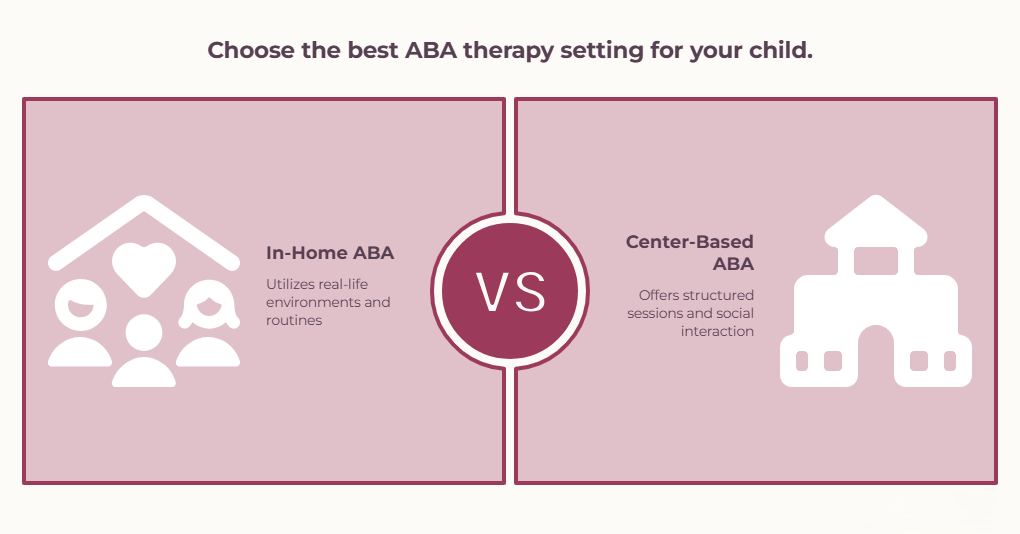
In-Home vs. Center-Based ABA: What’s Actually Different
In-home ABA means a Registered Behavior Technician (RBT), typically supervised by a BCBA, comes to your home. Sessions use your child’s real toys, real routines, and real environment, practicing a skill like requesting a snack happens in your actual kitchen, not a simulated one.
Center-based ABA happens at a dedicated facility. Sessions are more structured, often include planned opportunities to interact with other children, and give the clinical team a controlled space with fewer of the distractions a home naturally has.
What Research Says About ABA Therapy Settings
The honest answer is that neither setting has been shown to be categorically superior. Peer-reviewed literature reviewing home- and clinic-based behavioral intervention models describes real advantages on both sides, not a clear winner. [2] In general terms, the tradeoffs tend to run like this:
- In-home tends to help with: generalizing skills to daily routines, family involvement and coaching, and comfort for children who find new environments stressful
- Center-based tends to help with: structured peer interaction, a dedicated distraction-reduced space, and easier access to multiple specialists working from one location
Both can work well. What matters most is the quality and consistency of the intervention itself, not the setting alone.
The NYC-Specific Factors Most Parents Don’t Know
Most parents don’t know these factors. A few things worth thinking through specifically:
1. Apartment logistics. Not every NYC home has an obvious dedicated space for therapy, smaller apartments mean sessions might happen in a living room doing double duty, and some buildings (especially doorman or co-op buildings) require visitors to sign in or be pre-approved, which is worth sorting out before your first session.
2. The real commute, not the map distance. A center-based slot that looks close on a map can mean a real trip with a young child across boroughs via subway or bus, especially during rush hour. In-home therapy removes this entirely, which is a big part of why it’s common across NYC.
3. NYC’s school calendar affects center-based scheduling. If your child is also in school, center availability before or after school hours can be tighter than a provider’s general hours suggest, ask specifically about scheduling around the actual NYC DOE calendar, not just “school hours” in general.
4. Smaller households, less privacy. If you have other children or limited space, having a therapist in your home for multiple sessions a week is a different logistical reality in a smaller NYC apartment than in a house with more separation. It’s worth being honest with a prospective provider about this upfront.
Cost and Insurance for ABA Therapy in NYC
Both in-home and center-based ABA are generally covered under New York’s autism insurance mandate for medically necessary treatment. (We cover the mandate and what it does and doesn’t apply to in our Parent’s Checklist for Choosing an ABA Provider.) [3] The cost difference between settings usually comes down to structure, not coverage. Center-based programs carry facility overhead that can show up in billing. In-home programs have their own staffing and travel logistics. Either way, confirm coverage details with your specific plan rather than assuming.
If Your Child Is Under 3 (Early Intervention)
For children under 3 going through NYC’s Early Intervention Program, this question often resolves itself — EI services default heavily toward home or daycare-based delivery rather than a clinic setting. [4] (Full process in our NYC Early Intervention Program guide.)
What Matters in Any ABA Therapy Setting
Whichever you choose, the same non-negotiables apply:
- The treating clinician should hold an active NY behavior analyst license, not just national BCBA certification [5]
- Progress should be tracked with real data, not just described in general terms
- Parent training should be a built-in part of the program, not an afterthought
At NYC ABA Therapy, we offer both in-home and, depending on availability, center-based options. We’d encourage you to ask any provider you’re considering, including us, the same questions either way.
A Practical Way to Decide: In-Home or Center-Based ABA
- Lean in-home if: commute is a real barrier, your child does better with familiar surroundings, or daily-living skills (mealtime, routines, siblings) are a priority
- Lean center-based if: structured peer interaction is a current goal, your home doesn’t have workable space, or your child responds well to a dedicated “this is therapy time” environment
- Ask about a hybrid approach if you’re unsure, some providers offer a mix, and it’s a reasonable middle ground while you see what fits
Wait time is also worth factoring in — center-based and in-home openings don’t always move at the same pace. (Our guide to ABA waitlists in NYC breaks down why, and what actually helps.)
Frequently Asked Questions
Is one setting more effective than the other?
No single setting has been shown to be universally better — outcomes depend more on the quality and consistency of the program than on location. [2]
Does insurance cover both settings equally in NYC?
Generally yes, under New York’s autism insurance mandate, though it’s worth confirming with your specific plan since coverage details vary. [3]
Can we switch settings later if it’s not working?
Yes, this isn’t usually a permanent decision. Many families adjust as their child’s needs or family logistics change.
This article is for general information and isn’t a substitute for personalized guidance from a licensed clinician or your insurance provider.
References
[1] CDC – Treatment and Intervention for Autism Spectrum Disorder
[2] Peters, B., et al. – Advantages and Challenges of a Home- and Clinic-Based Model of Behavioral Intervention for Individuals Diagnosed with Autism Spectrum Disorder, Journal of Autism and Developmental Disorders
[3] Autism Speaks – New York State-Regulated Insurance Coverage
[4] NYC Health – Early Intervention Program
[5] NY State Education Department – FAQ for Licensed Behavior Analysts