Search “best NYC neighborhoods for autism families” and you’ll mostly find generic roundups like Williamsburg or the Upper West Side, with no autism-specific reasoning behind them. There’s no single “best” neighborhood in NYC, it depends on your child, your commute, and what you’re actually optimizing for. Here’s a real, place-by-place breakdown.
ASD Nest Access, Provider Density, and What Really Matters
- ASD Nest or Horizon program access: NYC DOE’s two flagship inclusion programs for autistic students
- Provider density: how many ABA agencies and specialists actually serve the area
- Lower-stimulation outdoor space: parks and quieter streets matter more here than in most cities
- Community and peer support: resource centers and parent networks near you
Why You Can’t Move Near an ASD Nest School in NYC
This is the part most guides get wrong: you can’t move near an ASD Nest or Horizon school and expect your child to attend it. [1] Placement runs through your child’s IEP team, not neighborhood zoning, the DOE assigns a specific school via a School Location Letter, which can be anywhere in the district. [2]
Don’t choose a neighborhood based on proximity to a specific Nest/Horizon school. Ask your IEP team which schools are realistically in play first, and ask specifically whether transportation is included in your child’s IEP if the assigned school ends up being far from home, NYC DOE often provides busing for this exact reason, so a longer commute doesn’t necessarily fall on you. We cover the IEP side of this in our NYC Early Intervention Program guide.
Upper West Side, Manhattan
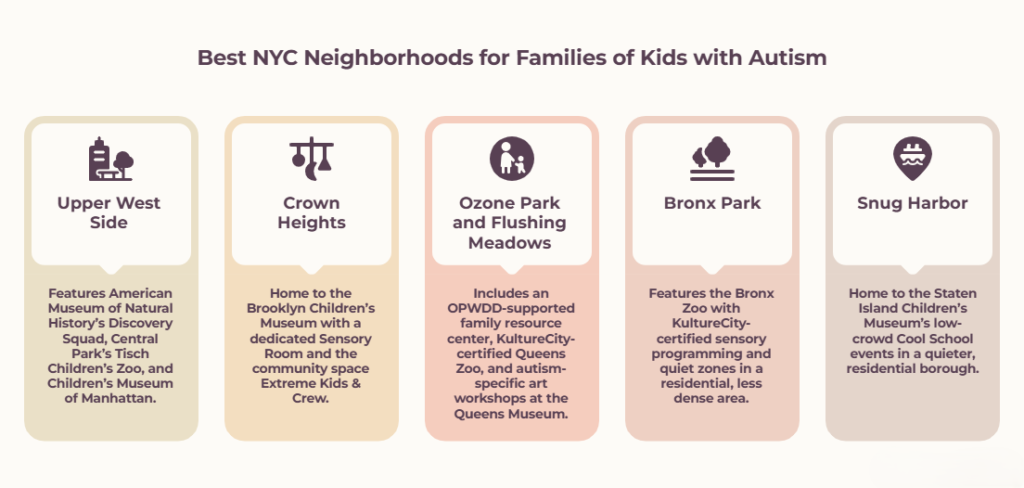
Home to the American Museum of Natural History’s early-access Discovery Squad program, and steps from Central Park’s Tisch Children’s Zoo and open lawns, genuinely useful for regulation breaks on a hard day. The neighborhood is also close to the Children’s Museum of Manhattan, which offers early-access mornings with reduced crowds. Provider density is high here, but so is competition for appointments, so it’s worth asking any provider about realistic wait times before assuming proximity alone will get you seen faster.
Crown Heights, Brooklyn
Home to the Brooklyn Children’s Museum, which runs a dedicated Sensory Room several times a week — a genuine rarity, since most museums only offer occasional sensory-friendly hours rather than a standing dedicated space. Extreme Kids & Crew, a community space built specifically for kids with disabilities, also has a Brooklyn presence worth checking directly for current hours and programming. Brooklyn overall has a strong concentration of ABA providers, given its size and population.
Ozone Park and Flushing Meadows, Queens
Ozone Park is home to an OPWDD-supported family resource center specifically for autism families. [3] A short ride away in Flushing Meadows Corona Park, the Queens Zoo is KultureCity-certified sensory inclusive, with free sensory bags and marked quiet zones, and the Queens Museum runs autism-specific art workshops. Queens is NYC’s largest borough by land area, so provider availability varies a lot depending on which part of it you’re in.
Bronx Park, The Bronx
The Bronx Zoo sits in Bronx Park and runs KultureCity-certified sensory programming, with marked quiet zones and seasonal sensory-friendly events. The surrounding area is more residential and less dense than much of Manhattan, which some families find easier day-to-day, even outside of scheduled outings.
Snug Harbor, Staten Island
Home to the Staten Island Children’s Museum’s low-crowd Cool School events. Staten Island overall runs quieter and more residential borough-wide than the other four, though the ferry-only direct connection to Manhattan is worth factoring into any commute-heavy therapy schedule — a real logistical tradeoff for a genuinely calmer environment.
Questions to Ask Before Choosing a Neighborhood
- How far is this area from providers who actually serve it? Map distance and real commute time aren’t the same thing in NYC, a provider “10 minutes away” by car might be 40 minutes by subway at rush hour. The same commute logic we cover in our Queens provider guide applies citywide.
- Does the building allow regular visitors, for in-home ABA? Doorman and co-op buildings sometimes require advance sign-in or a visitor policy that a therapist coming multiple times a week needs to work around.
- Is there a quiet outdoor space within a short walk? Not every block in NYC has one, and it matters more here than in most places.
- Is there an existing community resource nearby, like the ones above? Building a support network from scratch is harder than joining one that already exists.
None of these questions have a universal right answer, a family prioritizing provider access might make a different choice than one prioritizing a quieter environment, and both are reasonable.
Quick Checklist
- Don’t choose based on a specific Nest/Horizon school, ask your IEP team first
- Check provider commute times honestly, not just map distance
- Look for nearby quiet outdoor space
- Check for existing community resources before assuming you’ll start from zero
Frequently Asked Questions
Is there one best NYC neighborhood for autistic families?
No single one, it depends on whether you’re prioritizing provider access, community, or a quieter environment.
Should we move closer to an ASD Nest school?
Not based on proximity alone, placement is decided by your child’s IEP team. [2]
Does provider density really vary by neighborhood?
Yes, check directly with any provider you’re considering, since availability differs a lot across the city.
References
[1] Autism Spectrum News – The ASD Nest Middle/High School Model for Inclusive Education
[2] NYC Public Schools – Specialized Programs for Students with Disabilities
[3] OPWDD – New York Families for Autistic Children